

Steadying the Ship
How US military leadership acts as a force for stability

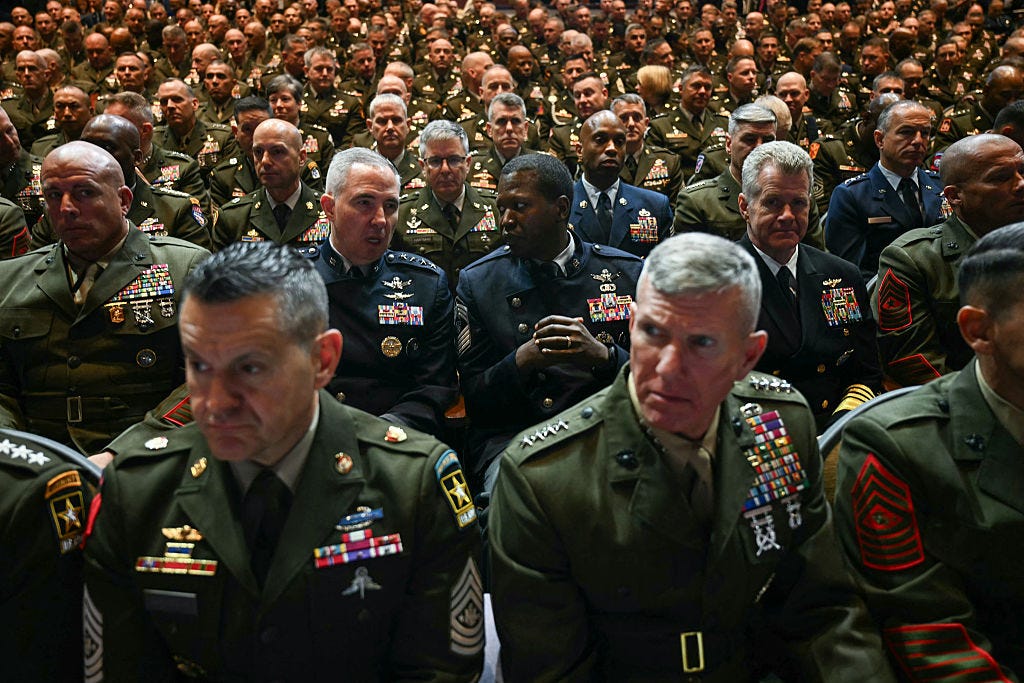
Much ink has been spilt about how Donald Trump has undermined Nato or alliances more generally. From the threats against Greenland to European leaders finding a political bounce in shunning his war against Iran, or the president’s general unpredictability, there is all too much evidence that the Transatlantic partnership as we knew it for decades no longer operates.
But what about after Trump? To what extent might harmony be restored?
I’ve been quite pessimistic about this too, not least because of the anti-European positions taken by Vice President JD Vance, a frontrunner for the Republican nomination, and even by Governor Gavin Newsom on the Democratic side. And let’s face it, whoever gets elected, is vanishingly unlikely to do so on a slogan of, “I want to spend more on the defence of Europe”.
While the imperative for Britain and its neighbours to step up, security-wise, is very evident, I find myself feeling more optimistic about one thing. We should not underprice the determination of the USA’s military leadership, as well indeed of its intelligence and law enforcement establishments, to keep the alliance going.
To be fair, you do hear our securocrats making this point, but you really have to experience it first hand to appreciate how important these relationships are. Having attended the Global Air and Space chiefs conference in London this week, I am feeling a little more optimistic about these ties generally and Nato in particular post-Trump.
The conference is hosted annually by the Chief of the Air Staff or professional head of the Royal Air Force and was attended by 60 of his counterparts. Taking in the speeches and chatting to these professionals in the margins it is quite evident that America’s senior military represent an important counterweight to the political tensions buffeting the western alliance, and indeed those inside the US.
Don’t take my word for it, the theme was explicitly tackled in a keynote by the US Chief of Space Operations General Chance Saltzman. Having been the first boss of this new force, he is about to retire and was therefore in reflective mood. Such was his candour that I will quote him at length:
“In the hyper-political environment we find ourselves in, with partisan politics creating divisions between a multitude of stakeholders, I remind myself that military institutions in our democracies, particularly military leadership, serve as the ballast in the ship. While it may feel like this ballast slows progress as the ship of state attempts to quickly move towards its goals, the ballast creates stability when the inevitable storms arise. We as military leaders in our democracies must remember our roles, think long-term, offer our military experience to decision-makers, and do what we can to provide stability and be a calming presence”.
Saltzman’s caution about waging war in space – noting the unpredictable consequences – seemed sane and measured compared to that of an earlier generation of US military leaders and their talk of ‘full spectrum dominance’. No doubt, the environment is evolving quickly, with countries like China gaining capabilities that make it unwise to assume there would be any ‘winner’ from a war in space.
But in a week in which defence secretary Pete Hegseth announced that testosterone supplements would be available to personnel who lack sufficient ‘testiness’, the avoidance of simple formulas about American dominance was welcome.
So too was the appreciation of allies. Gen Saltzman remarked, “we are stronger as a team of nations than any one of us is individually. There is far too much evidence over the last 80 years or so to argue otherwise”.
His words about the senior military acting as a force for stability reminded me of General Mark Milley, formerly US Army boss and Chairman of the Joint Chiefs, keeping open back-channels to China during the final months of Trump’s first term. But of course, Milley earned his enmity and that of the MAGA base, resulting in his security clearance and bodyguards being taken away when Trump returned to office.
In the roiling atmosphere of today’s Pentagon, those suspected of heresy or acting as part of the ‘deep state’ or ‘blob’, ie frustrating Hegseth’s agenda, can expect to be sidelined or sacked. So Saltzman’s courage and care in his choice of words was quite something.
Earlier this month General Chris Donahue, commanding allied and US land forces in Europe stepped down after Hegseth took against him. Senior Nato officers on the margins of this week’s conference lamented Donahue’s fate, one telling me, “I suspect we haven’t heard the last from him”.
What could that mean? As a former Delta Force commander, Donahue is evidently both courageous and comfortable with risk, so will he speak out publicly against this administration’s efforts to impose ideological purity on the general staff?
Probably not, I inferred. But the example of the current Chair of Joint Chiefs, USAF General Dan Caine, who had left the military but was recalled to duty by Trump, was raised. Might Donahue also return at some future point?
Fears were expressed to me that having chased out those whose views Hegseth disagrees with or who are too-independent minded, a follow on Democratic administration might feel the need to do its own purges – of those who passed the MAGA purity tests. “I fear it could take fifteen years to straighten this all out” one senior serving officer told me.
Surviving the next couple of years no doubt requires America’s generals to be most careful in their choice of words. But I do feel more confident at the end of this week that their emphasis on alliance partnerships and joint action, once just cut and paste cliché for a conference of this type, has assumed a new meaning in the light of the treatment meted out to general officers like Milley and Donahue.
The current US Air Force boss, General Kenneth Wilsbach, also spoke at this week’s conference in London. As a relative newcomer to his role there was evidently a measure of caution in what he said, but again he’s worth quoting:
“our greatest advantage is not any single platform, weapon, or technology, it is our network of allies and partners willing to stand together in defence of shared interests, values, and responsibility… the most effective airpower is combined airpower… one of the most powerful deterrent signals we can send is demonstrating that free nations are united, capable, and prepared to act together”
So while the abuse or belittling of allies comes all too easily to Hegseth and Trump, America’s military leadership clearly understands their value. More than that, they are trying to reassure us, from the podium and in the corridors, that they will do their best to restore the security relationship with Europe in the years to come.
This is comforting to hear. I remember a Times podcast, discussing (on different occasions) the connections between British military leaders and Japanese leaders, as well as Pakistani. The British General spoke a lot about how important these relations are and how they try to keep the connections going. Top brass come in for all sorts of criticism, but they understand the value of inter state relations.
The military as a force for stability sounds highly dubious more than a few countries have a force for stability that can't be got rid of and answer to no one