

Putin's Hot Summer
Ukraine is raising the price of ongoing war

Ukraine’s fight back against Russia has scored some notable successes in recent weeks. Ten days ago, in the Sunday Times I flagged up some key developments, trying to assess what it meant to the overall course of the war, but here I can go into more detail
Also, since I wrote that, things have only got worse for Russia as a series of spectacular strikes on Moscow has shown the Ukrainian ability to bring home the war to the core population most protected by Vladimir Putin from its ugly realities.
Given the number of false dawns, and the overselling of Ukraine’s abilities for years by certain over-zealous partisans, some caution is naturally in order. Russia retains advantages as the larger, more populous, nation, and if Putin really starts to feel things slipping away, he has options for escalating the conflict, trying to frighten his neighbours and the West more generally into backing off.
But there are some developments that, at the very least, mark an evolution in the course of the war, increasing the pressure on the Kremlin. And in an influential analysis published last month, Nigel Gould-Davies of the International Institute for Strategic Studies, argued that Putin has very little leeway left, be that in arms production, finding more soldiers, or financing the war.
So let’s list what I consider to have been the key developments of recent weeks – allowing that some of these changes have been in the pipeline for years.
Frontline Attrition
We all know that Russia has for years accepted losses at a scale that would have caused western governments to throw in the towel after a few weeks. In recent months HUR (Ukrainian military intelligence) has been claiming that it’s been meeting or exceeding its target of putting 30,000 or more Russians out of action each month. That means ‘deleting’ more soldiers than they can recruit.
Adding to the mind-boggling claims, the Director of GCHQ last month claimed that western agencies assessed half a million Russian soldiers had been killed in the war so far. There have been arguments about the definition of casualties and loss rates throughout the war, but HUR has introduced a new system for compiling verifiable evidence of Russian losses. It takes the form of a macabre competition where units get rewards for their kills.
Much is unclear about this deadly contest but it is evident that both sides have ramped up their production of the First Person View (FPV) or small killer drones used on or about the ‘zero line’. Ukraine is now for the first time close to Russian production figures and claiming a 5:1 advantage in casualties caused. Personally, I doubt that growing numbers of FPVs can on its own win the war for Kyiv, but in causing so many casualties they add to the financial costs of war for the Kremlin, which must compensate the victims or their families and constantly raise the sign-on bounty for those obtuse enough still to head for the front.
The 50-200km Band
It is when you look at the battle beyond the front and its immediate sterile hinterland that things start to look more important. At these ranges, the Russians cannot use fibre optic cable to make their drones un-jammable. The spools of this fine line cannot be made that long (yet!).
To add to the Russian army’s problems, Starlink has since February shut them out of its satellite system, which they had been using to control some of their longer range drones. So now it’s just the Ukrainians that can exploit it, and it’s very hard to jam.
Combine this Starlink factor with growing numbers of drones or missiles operating at this depth and it had given Kyiv a big operational edge. They’ve been using that to hit ammo dumps, command centres, and all the rest.
This advantage has been wielded to the greatest advantage in Crimea and parts of occupied Kherson district that the Russians use as a ‘land bridge’ to that key territory.
The authorities in Crimea have declared fuel rationing, Russian social media is full of anguished accounts of supplies running low and complaints about the ineffectiveness of their air defences. This week, in a sign of how carefully thought out its campaign is, the Ukrainian military hit three key ferries that ply the Kerch Strait between Crimea and Russia. The isolation of this key peninsula seems a very real possibility now.
Deep Strike
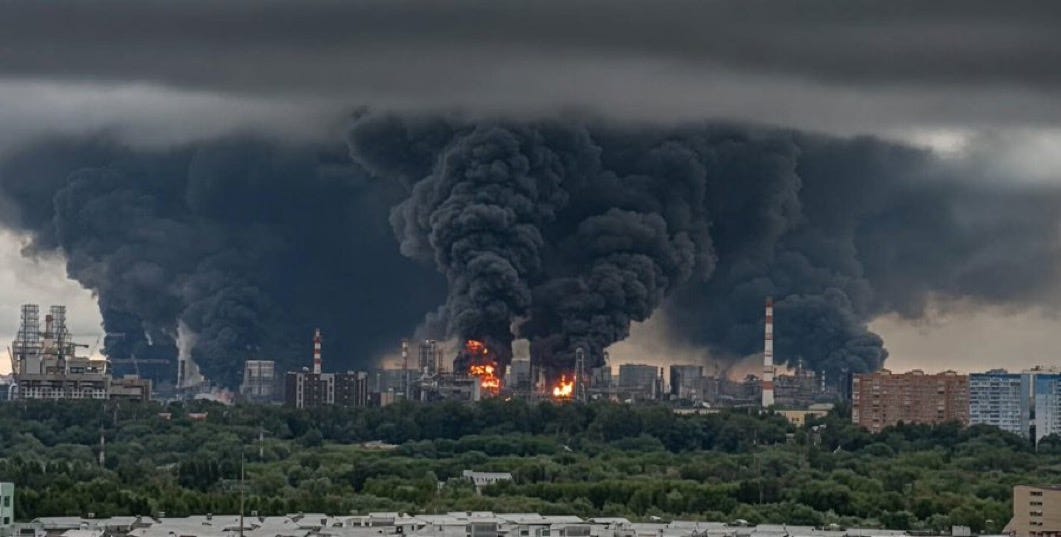
Repeated strikes this month on an oil refinery at Kapotnaya South-East of Moscow have produced dramatic images and exposed the limitations of the capital’s air defences. Ukraine has been striking in depth, particularly at oil installations, for a couple of years, so again the salient question is, is this changing meaningfully now? As with the shorter range systems, production initiatives begun some time ago are now delivering big numbers.
They are also allowing a wide variety of attack profiles, the recent Kapotnaya strike employed around 200 drones, encompassing jet and propeller powered ones flying at various altitudes. Copying the tactics Russia has used for years, careful timing allowed drones launched from widely scattered sites to arrive simultaneously at the desired times.
On 22nd June, the Ukrainians struck a key Sborka electronics plant in Voronezh nearly 600km south of Moscow. By all accounts it’s a key location in the production of microchips and other electronics for the Russian military. This attack – arguably of greater military importance than the Moscow refinery – was not apparently carried out by drones at all.
Accounts differ as to whether the Voronezh strike used Storm Shadow cruise missiles or newly received AGM-188 ‘Rusty Dagger’ missiles. The latter were developed at speed by American contractors specifically for Ukraine having a range of more than 800km. More than 3,000 are on order, the first ones having arrived in October.
Either way, the use of advanced cruise missiles would involve manned aircraft from the Ukrainian air force (likely Su-24 for Storm Shadow or F-16 for Rusty Dagger), in case you think war is now all about drones. These are advanced weapons, and evidently accurate, given the built-up surroundings of the target area.
Escalate or Ceasefire?
There’s no doubting the embarrassment for Putin of these major strikes in St Petersburg and Moscow, or that the use of western supplied cruise missiles in Voronezh will infuriate him. In the past he’s sometimes resorted to nuclear sabre rattling, and more recently some analysts have connected a growing number of drone incursions in the Baltic states with the uptick in Ukraine’s strike campaign, suggesting bigger provocations against these Nato members might be another option for the Kremlin.
It must also be very galling for the Russian leadership to see how effectively the Ukrainians are now interdicting Crimea. Putin’s seizure of the territory in 2014 was such an important and popular moment for him that the present situation must rankle.
That assumes of course that he knows about it and the stories of him being lied to by his generals are legion. That IISS study I mentioned earlier suggests the Russian leader may be coming to some sort of crunch where, unable to squeeze any more out of the military or economy he has to take drastic action to mobilise more resources or accept a ceasefire.
Adding to these dilemmas are the apparent calming of the situation in the Gulf. As world oil prices fall, that’s another problem for the Kremlin, given its dependence on energy exports for money.
Again, prediction is a perilous thing here. What one can say with certainty is that Ukraine’s ability to harm Russia, whether that’s killing men on the front, lighting up the Kerch ferry, or causing black rain to fall in Moscow is growing significantly. The ball is now in Putin’s court.
Excellent.
Thank you, you painted in a number of details I didn’t know, and stitched it all together in an illuminating way.