

'Most Inveterate Enemies'
How America's revolution divided the English speaking world

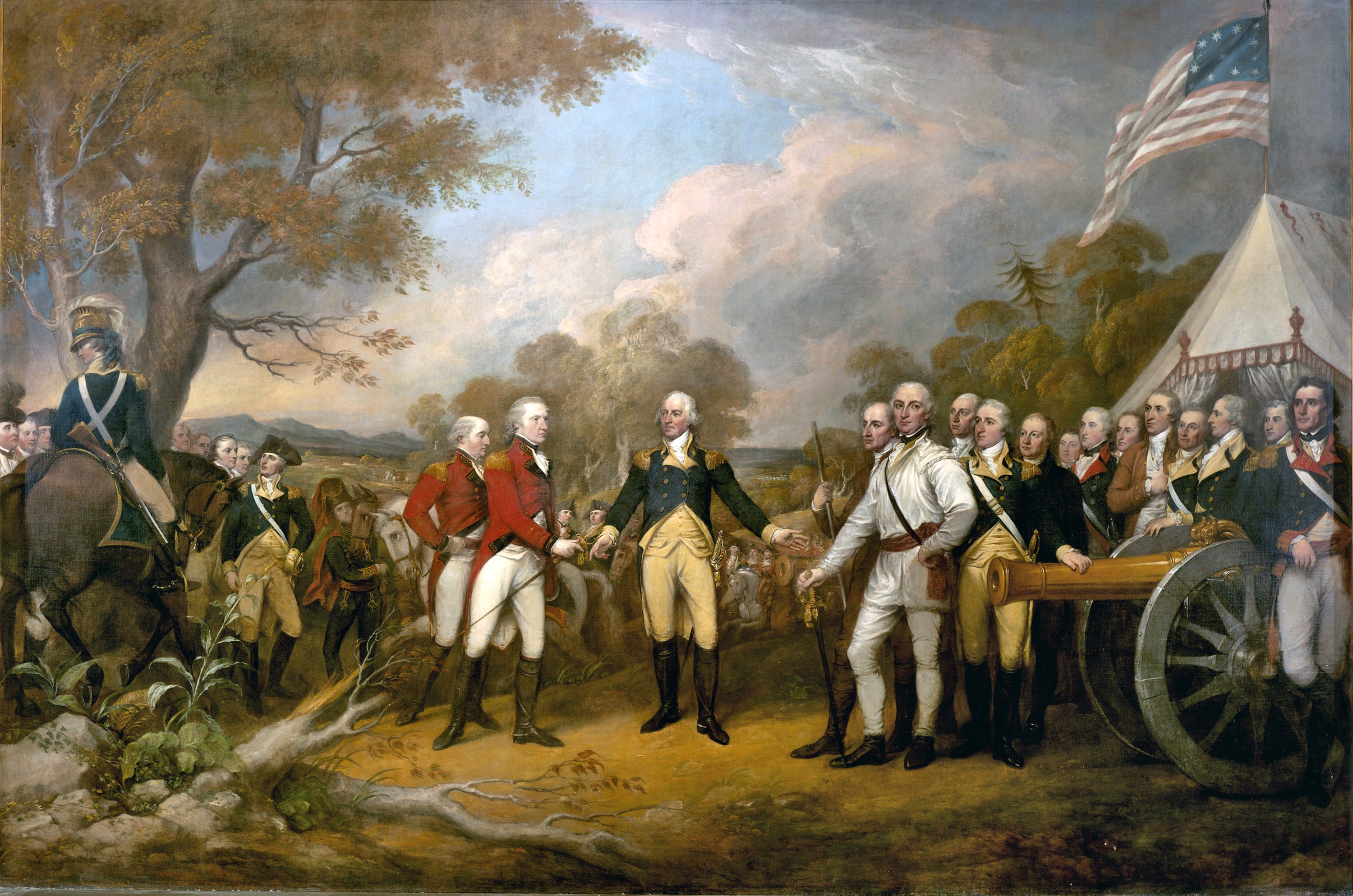
It’s 250 years since the American declaration of independence but the war had actually started fifteen months earlier in Boston. During that period many of the colonists claimed that they would remain subject of King George III if a new deal could be hammered out with their faraway sovereign.
The idea that they had been driven to revolt by the stupidity of ministers but remained loyal to their king came about in part because many thought the monarch was part of a divinely ordained ‘hierarchy of order’ against which rebellion was not only a sin but ‘unnatural’, a word often used by their British enemies to characterise the revolution. And while this confusion among the rebels continued it found many forms, not least that the colours under which many of George Washington’s regiments fought during that first year had the British union flag on them.
But by the time independence was declared in Philadelphia in 1776 their leaders at least had recognised that this was a definitive break with the mother country. Hundreds of thousands of loyalist Americans begged to differ, fighting the revolution tooth and nail.
So today I am re-posting a piece I wrote at the 250th anniversary of the war breaking out in Boston, when few of you subscribed to this blog. It’s based on deep research on the journals and letters of the time and is about what the redcoats thought of their enemies. Were they brothers or foreigners? was this a continuation of the long struggle at home between Whigs and Tories or something very different? and how best to quell the revolt?
That gap between the outbreak of war and the declaration of independence was a critical time in the emergence of an American national character. If nothing else, sifting through the papers of those who served King George III in that distant campaign, even 250 years later the vitriol and wry humour make for entertaining reading.
Are they Like Us or Not?
From the get-go, as companies of militia armed themselves around Boston, preparing to take on the King’s troops, this question of whether they were kith and kin or not preoccupied the garrison. Because if they were the same people, did that mean you had to go all out for reconciliation, or on the contrary was this rebellion that had to be put down as brutally as the Scots had been in 1745.
Writing home weeks before he was picked to lead the expedition to disarm the rebellious militia at Lexington and Concord, Brigadier the Earl Percy expressed the hope that he would not be given exactly such a mission: “I cannot say this is a business I very much admire, I hope it will not be my fate to be ordered up with them”.
Captain Harris, of Percy’s regiment, the 5th Foot, also wrote home, “though I must confess I should like to try what stuff I am made of, yet I would rather the trial be with others than these poor fellows of kindred blood”.
For many in the garrison, talking over the rebellious goings on, as they supped their drinks in Boston’s coffee houses, this was a civil war which echoed England’s 17thCentury struggle between the King’s party and those who wanted the landed gentry to have more power – factions characterised as Tories and Whigs respectively. ‘Brother Jonathan’ or just Jonathan, terms often used by British soldiers for the rebels was an English Civil War derogatory name for the King’s Roundhead enemies.
Indeed Lieutenant Richard Williams believed it was the same families causing the trouble, often puritans, who had enthusiastically backed the English revolution but emigrated to America after the return to power of the king in 1660: “these people have not in the least deviated from the steps of their ancestors, always grumbling and unwilling to acknowledge the authority of any power but what originated among them. They certainly have long looked forward to the day of independency”.
If Brigadier Percy or Captain Harris dreaded seeing action against the colonists, it was precisely because as Benjamin Franklin put it, it was a quarrel between ‘English men’, that not only had it roots in the Old Country’s history but was still very much being played out in London and Dublin in 1775. Many of the biggest landed families in those cities supported the colonists and did not want George III to succeed in suppressing the revolt by force.
So Percy, whose father (the Duke of Northumberland) had voted against the Stamp Act, that helped trigger the revolution, had a good deal of sympathy with those resisting the king. But, and this is critical, while he opposed the war, he heartily disliked the American Whigs. His experience of trying diplomacy with the Select Men of Boston left him agog at their refusal to compromise. Writing to England in August 1774, he blasted them: “the people here are a set of sly, artful, hypocritical rascals, cruel, and cowards. I must own I cannot but despise them completely”.
Among the king’s troops, that idea of hypocrisy loomed large. They believed revolutionary firebrands like Hancock, Adams, and Warren were uninterested in compromise, were out for themselves and taking advantage of a credible populace. Commenting on the state of Boston after fighting began when these leaders and thousands of other Whigs or rebels left the city Lt Williams reflected that it had, “no such thing as a play house, they were too puritanical a set to admit of such lewd diversions, tho’ perhaps no town of this size could turn out more whores than this could. They have left us an ample sample of them”.
The use of the pulpit in particular to preach rebellion rankled with many officers. And once the populace or rather that section that sympathised with the Patriot or Whig cause became more militant, abuse of the king’s troops became common. In the months before Lexington and Concord they were often spat at, stoned, or abused verbally as ‘lobsters’, ‘bloodybacks’ and so on. This brought many to the conclusion that, “these lawless people” were not the same as the British, that they had evolved a distinct national character.
This was put most cogently by Major Henry Blunt, writing home the year before full scale rebellion broke out: “the Patriots, like some of ours indeed, have started up from obscurity by talking loudly of Liberty to a crowd of fellows that know nothing of it, rascals that have emigrated from, or been banished from their own country and sold themselves here as slaves. These people, most of them originally Scotch or Irish, have united in marriage with French, Germans and Dutch and from them have sprung the high-spirited race that boast so much of British Blood and British Liberty, and who have had the folly and impudence to talk of chastising Great Britain”.
The Early Bitter Lessons
In the days after Lexington and Concord, in which British troops showed indiscipline and were harried for miles by American militia as they hastened back to the city, there was much uneasy comment. The settlers who had performed very well were animated by ‘enthusiasm’, an earnest belief in their cause, and had been expertly trained by those who had served the crown again the French during the earlier wars on the Canadian frontier.
“Whoever looks upon them as an irregular mob, will find himself much mistaken”, Percy wrote after his brigade’s rough handling on 19th April, “they have men amongst them who know very well what they are about, having been employed as Rangers against the Indians and Canadians… for my part, I never believed, I confess, that they would have attacked the King’s troops”.
When the Patriots gave battle on Bunker Hill a couple of months later the results were even more disturbing, 226 redcoats were killed and 900 wounded. “We have learnt one melancholy truth”, one of the British officers wounded in the battle reflected on his sick bed, “which is, that the Americans, if they are equally well commanded, are full as good soldiers as ours, and, as it is, are very little inferior to us even in discipline and countenance”.
Following these setbacks the British abandoned Boston and waited for reinforcements. When they took the war to New York in 1776 the ultras among them hoped to use harsher measures. Colonel James Grant, a Scot who was close to the commander in chief who had derided the New England people as, “bible-thumpers”, wrote at the outset of the new campaign, “lenity is out of the question, or ought to be, for depend upon it, this continent is lost to Great Britain, if it is not crushed and conquered, exceptions may be made, but Boston and Philadelphia should be treated with the greatest severity”.
Defeating General George Washington’s army in New York that summer, some argued for extreme measures against the American captives. Captain Frederick Mackenzie wrote, “an exchange of prisoners is talked of. The measure may be right and politic; but it appears rather extraordinary that under the present circumstances we should treat them as if on an equality”. While aware that some, like Grant, argued they should all be put to the sword, Mackenzie felt, “although the humanity hitherto shown to the Rebels has not had the desired effect, I hope it may in the end; and I am of the opinion it is right to treat our enemies as of they might one day become our friends”.
Though the British won many battles they were defeated in the summer of 1777 at Saratoga, triggering the entry of France into the war, which in turn helped produce the defeat at Yorktown in 1781.
Defeat and Reflection
The loss at Saratoga and entry into the war of France caused attitudes among the British troops to harden. After all, if the Americans were siding with the old enemy wasn’t this treachery of the worst kind?
Even those from British families hostile to the policies of George III who believed his American war was futile, the feeling of betrayal by the inhabitants of the 13 colonies was clear. “Every day confirms me the more, in my old opinions”, wrote Brigadier Charles O’Hara of the Guards in 1780, “that England has not only lost this Country for ever, but must for ever consider the people of this Continent, as the most inveterate of her enemies”.
Of course, not all colonists sided with the revolution – far from it. It was often suggested around one third remained loyal to the crown. And as the conflict came to a close, many of them decided they wanted no part of an independent America, around 10% of the entire population chose to leave, heading for Canada, the Caribbean, and the British Isles. Major Richard Dansey of the 33rdFoot, at New York in 1783 as ships carrying these refugees departed, commented, “the desertion of the loyalists is looked upon by all of us as the most dishonourable act that was ever done by a nation”.
Of course there were some, notably among the contingents hired from German princelings who admired what the rebels had achieved. Although there were significant settlements of German immigrants too, the Hessians and other foreigners fighting for Britain did not take the revolution as personally as many of the British officers.
“Although I shuddered at the distress of these men”, wrote the Hessian Jaeger Captain Johann Ewald after watching Americans file by in ragged uniforms near the end of the war, “it filled me with awe for them, for I did not think there was an army in the world which could be maintained as cheaply as the American army… to what cannot enthusiasm led a people !”
As the British fleet sailed off form New York in 1783, quite a few could not reconcile themselves to the loss of the war, making predictions that the colonists would soon be at each other’s throats. General Guy Carleton, the governor of Canada, was convinced that, “another revolution as inevitable and at no great distance”, the new republic would not hold, because he wrote, “many [Americans] look back with regard on the tranquillity and happiness of former times and are persuaded that neither peace nor safety can be procured but under their former government”.
These tensions did contribute to further warfare in 1812. But the conviction on the part of many Redcoats that the Americans would return to their ‘true allegiance’ proved mistaken.
For more on the Redcoat’s’ war, my book Fusiliers tells the story
Thanks for an excellent article. As a Brit, I was largely unaware of the background to this, having a very simplistic view. It was interesting to read about it in the context of British politics at that time and also to see it against other fights by resistant colonials.
The American revolution is most usefully seen as a hostile management buyout. Left the same people running the place under a new structure. The pious waffle in the Declaration of Independence was just a PR gloss ( which Jefferson - a shifty, Blair-like figure - was good at )
Bit like William the Conqueror's PR blitz after his 1066 coup.