

Game Over
Britain's failure to fund defence adequately is a turning point

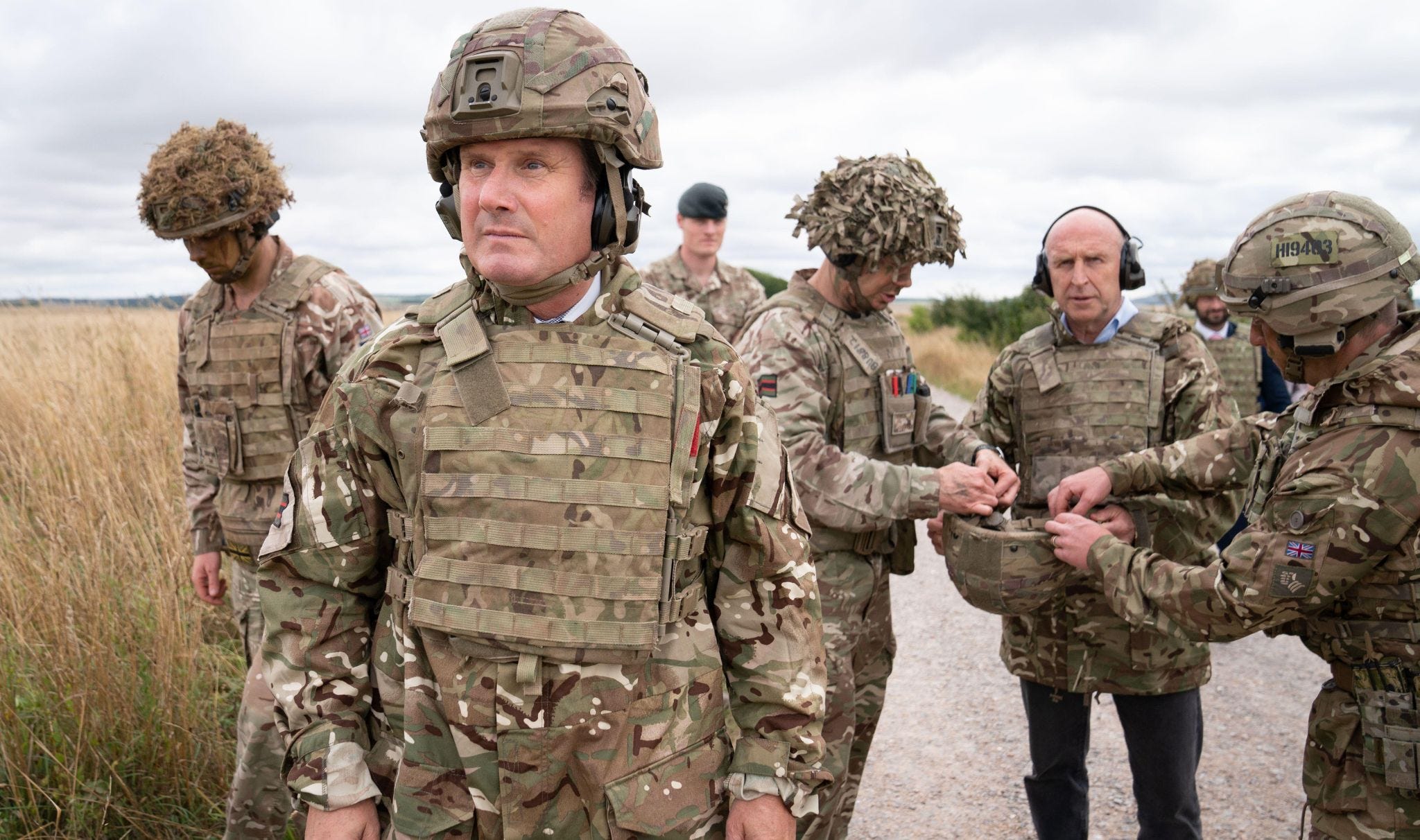
If we are to take one lesson from the British government’s defence car crash of the past week it is that the battle to reverse this country’s long term decline as a military power is over. Faced with the prospect of trying to switch billions from benefits to rebuild our national security, they have buckled, and barring an existential 1939-style crisis, this discussion is now over for the foreseeable future.
As historical setbacks go, what has happened is as significant as the 1956 Suez Crisis. Certainly, the deal that Keir Starmer offered John Healey – of increasing defence spending to 2.68% of Gross Domestic Product (GDP) by 2030 was so bad that it triggered his resignation, and renders Britain’s Nato pledge to get it to 3.5% of GDP by 2035 a near impossibility.
The ‘back loading’ of the spend needed to reach that target was flagged up in Healey’s resignation letter. It means you need to find so much more cash during 2030-35 that it’s hard to see any government, whether Labour, Tory, or indeed Reform, managing it.
To add insult to injury, Downing Street continues to insist that it was an amazingly generous offer that could only be achieved by strong-arming other government departments. And because of this, it is also suggested by No10 briefing, Dan Jarvis, Healey’s successor as defence secretary, could not plead for more as a condition of taking the job, the decision is settled.
There is a chance, in an attempt to avoid the disastrous implications of such an outcome, that the service chiefs may go to Andy Burnham, if he comes the next PM, threatening resignation. Given that he has shown a tendency to make policy on the basis of the last person he listened to (note his flip-flop over the ‘Waspi’ pensions case, something that could have added billions a year to the benefits bill) perhaps it’s worth a try.
But smart people who know the defence world – like former National Security Adviser and Cabinet Secretary Lord Mark Sedwill, have already been thinking through the implications of Starmer’s settlement, and projecting the loss of one of Britain’s major defence roles: strategic nuclear weapons; a navy capable of operating against peer adversaries in the North Atlantic; air forces able to support our allies in northern Europe; and an army that can be deployed on the Continent in support of Nato. Hinting that this last capability is now unaffordable (bad news for the Army in other words), Sedwill posted on social media this weekend, “Britain can’t sustain a ‘balanced force’, we need integrated forces to protect the North Atlantic and High North against Russian aggression and hold their Arctic bases at risk”.
That brings us back to the reality of that slo-mo spending timeline approved by the Treasury, estimated to yield £13bn more for defence over the next four years rather than the £28bn service chiefs wanted. It means that instead of glimpsing the sunlit uplands, as last year’s Strategic Defence Review encouraged us to do, with its talk of putting the country back on a footing where it could defend this country against the forces of another state, we are now back to ‘painful choices’ and likely losing a major capability even though the money is still going up a little.
If you believe the counter-briefing we’ve heard from Labour figures hostile to Healey, this is because the Ministry of Defence is so useless at running its projects that it will waste any more money it’s given. Well, yes, there’ve been some stinkers, project-wise, over the years, Healey can be criticised for being too slow to reform the department and not going far enough in his re-think of procurement.
That said, the emphasis on projects that have gone wrong is usually a distraction by those who don’t want to spend the money on defence at all. Is the record of other departments – from HS2, to nuclear power, or NHS IT systems – really so different, if you cherry pick the worst examples?
In fact, the reason that the hitherto modest increases in defence spending have yielded so little up to now is because it is a system that was broken by successive governments that mouthed glib nonsense about war between states being a thing of the past, chosing to save money by kicking vital programmes into the long grass. If you don’t order a new frigate for 17 years or skimp on Trident by shutting maintenance facilities and postponing refits, while repeatedly dodging decisions about new facilities for manufacturing nuclear warheads, then correcting these problems will cost you tens of billions.
Prevarication and a pretence that all was still well was the only way to balance the books ten years ago, when it was already quite clear that the post-Cold War peace dividend was over and the taps would have to be turned back on. Britain did spend 3.5% of its GDP on defence back in the Eighties – go back to 1961 when I was born and it was 6%!
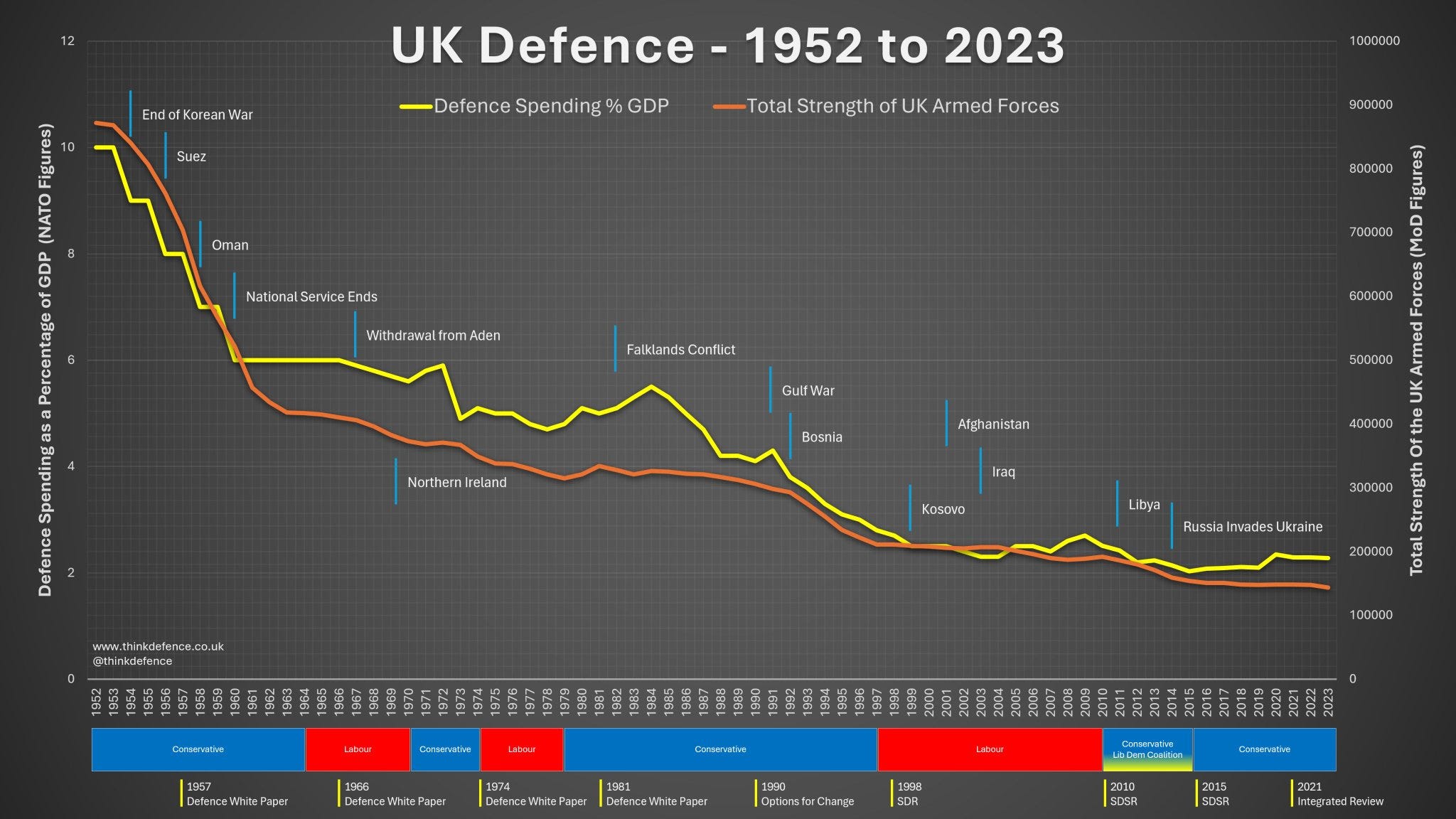
Please forgive me for reproducing my favourite graph – that of declining defence spend. There are others that show the steadily rising cost of entitlements.
Nobody would suggest a 6% defence spending effort now – instead we have a country that has stumbled when asked to aim for half of that. And all at a time when it has become crystal clear that the United States’ willingness to defend Europe is vanishing.
In the space of a few years, Britain’s ability to lead that rebuild of European defence has ebbed away too. It is tumbling down the league table as a proportion of GDP spent (UK was 3rd highest in Nato in 2014, 12th in 2025), or deployable forces. The total spent is still high, but that brings us again back to the huge costs of maintaining nuclear weapons status.
So you hear the barbs about ‘Belgium with nukes’ and grumbling from the Nordic and Baltic countries that Britain is no longer fit to lead the Joint Expeditionary Force. And even if the current attempts to recapitalise the armed forces go well, things may not yet have bottomed out.
We may go down to a couple of frigates in commission during the next year or two. Even the ability even to maintain Trident nuclear submarines patrols may falter before the replacements are fit for service. Changing that outlook would require a spending commitment this government is evidently unwilling to make.
Yup. The rot really started with Osborne's austerity budget after the GFC - but each and every government since then has its share of the blame.
The big question - is there a politician out there with the balls to remedy this?
Are the lessons from Iran and Ukraine of any relevance. Just spending more % of GDP has always seemed naive and simplistic. Aircraft carriers, F35s, Ajax etc one could go on and on repeating the same mistakes without even having to quote Albert Einstein.